


Guidance13 February 20263 min read
The fitting: what one hour in the atelier decides.
Some thirty measurements, a posture read, a few questions about your days: the appointment that settles how a garment will hang, long before the first cut.
By Gilles Masson, Atelier Mesure, Paris 7ᵉ

A made-to-measure suit does not begin with a cloth or a colour. It begins with an hour spent standing in the light of an atelier, letting someone look at you. It is the least spectacular moment of the whole process and by far the most decisive: everything that follows, the pattern, the cut, the alterations, comes out of it.
The measurements, and what they leave out
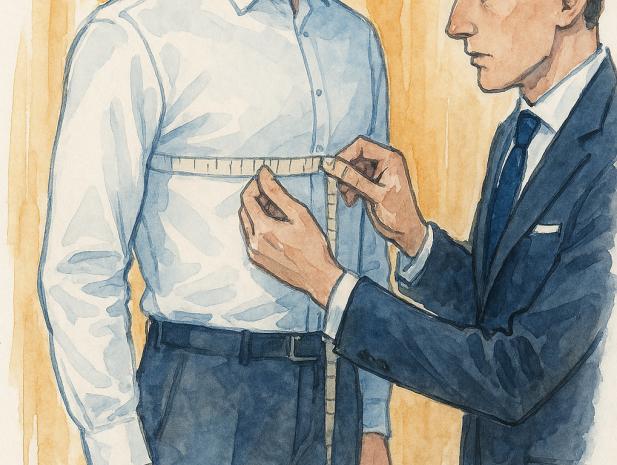
A fitting records some thirty values: chest, waist, seat, back length, shoulder height, arm girth and length, inseam, knee height. The tape passes twice over the same place, once relaxed and once drawn in, and the gap between the two is written down as well.
Those figures are not enough. Two men with identical measurements do not wear the same jacket: one has a sloping shoulder, the other carries it high; one stands with a hollow back, the other rounded by years at a desk. A measurement describes a volume, not a posture, and it is posture that makes a garment hang straight or askew.
Posture, read by eye
Which is why the appointment starts before the tape. You are watched walking, sitting, folding your arms. One shoulder lower than the other is noted, and almost everyone has one, along with a chest carried slightly forward, or a pelvis that tilts.
Those observations become pattern corrections: half a centimetre taken out of the left armhole, a back lengthened by eight millimetres, a dart moved. None of it appears anywhere on the measurement sheet, and it is what keeps a collar flat against the neck when you reach forward.

Your days go into the pattern
The third stage is a conversation. How many hours seated, how many in meetings, in a car, carrying a bag across the shoulder? A suit worn eight hours at a desk is not cut like a ceremony suit worn three hours standing.
The answers move concrete decisions: extra room through the seat for someone who drives a great deal, a more breathable lining for someone who travels between appointments, a softer construction for someone who wants to be able to forget the jacket is there. It is also the moment to talk cloth, because the weight of the fabric changes how the cut has to be handled.

« A well-cut garment is not noticed. The man wearing it is. »
Key points
What to know before the first appointment.
- Allow an hour, and come in a fitted shirt rather than a jumper
- Bring the shoes you will wear with the suit: they set the trouser length
- Stand naturally, without pulling the stomach in or squaring the chest
- Mention any recent change in weight, and in which direction
- Say what you do with your days, not only what you like
- A baste fitting follows: nothing is settled on the first day
- Your measurements are kept, so a second suit starts well ahead
A fitting done well is recognised months later, in the fact that you never once think about the suit while wearing it. For what comes next, from the baste fitting to delivery, the making process sets out every stage.
