Exceptional closureClosed until 31 August - reopens 1 September.

Style guide · Atelier Mesure, Paris 7th

Suit Construction & Canvas

Understanding the different construction methods: fused, half canvas, full canvas - and their impact on quality and durability

7 chapters6 min read
The Importance of Suit Construction

The Importance of Suit Construction

The construction of a suit is invisible but determines everything: drape, durability, comfort, and how the suit evolves over time.
Three main types of construction:
Fused (entry level)
Half Canvas (standard)
Full Canvas. The canvas is inserted between the outer fabric and the lining. This centuries-old technique is what distinguishes a quality suit. Key points: Construction defines drape, comfort and longevity Canvas construction allows the suit to breathe and gradually mould to your body type The full canvas surcharge (300-500EUR) pays for itself over 15 to 20 years, offering a durable and elegant investment

  • Construction determines: drape, durability, comfort, and how the suit evolves over time
  • Canvas construction: the traditional method allowing the suit to 'breathe' and mould to your body
  • Investment: the full canvas surcharge (300-500EUR) is amortised over a 15-20 year lifespan

Fused Construction

Entry Level
Fused Construction

Industrial method where a synthetic interlining is bonded to the outer fabric using heat and pressure. Standard for entry-level and mid-range off-the-rack. Fast and economical, but inferior quality and limited durability.

  • Method: Industrial heat bonding
  • Production time: Fast (2-3h for structure)
  • Durability: 2-4 years with regular wear
  • Body adaptation: None (permanently rigid)
  • Breathability: Poor (bonded layers restrict airflow)
  • Care: Degrades with repeated dry cleaning
  • Price: Economical (suits under 500EUR)
  • How to recognise: Artificial stiffness, abnormal sheen under pressure
Entry level, industrial production Fused construction involves bonding a synthetic interlining to the outer fabric using heat and pressure. A rapid and economical method, it is the standard for entry-level and mid-range off-the-rack suits.

Avoid for a long-term suit investment. Acceptable only for very occasional wear.

Half Canvas Construction

Made-to-Measure Standard
Half Canvas Construction

Quality-value compromise. Horsehair canvas hand-stitched on chest and lapels (critical areas), fused on lower jacket and back. Standard made-to-measure for the Essential and mid-range. Good balance of quality, durability and price.

  • Method: Hand-stitched canvas on chest, fused elsewhere
  • Production time: Moderate (10-12h for structure)
  • Durability: 5-7 years with regular wear, 10+ with occasional wear
  • Body adaptation: Good in the chest area, limited elsewhere
  • Breathability: Good upper body, moderate lower/back
  • Care: Withstands dry cleaning well
  • Price: EUR 980-1,290 made-to-measure
  • Ideal for: First made-to-measure suit, daily professional wear
Half canvas combines hand-stitched canvas on the chest and lapels with fused interlining on the lower jacket and back. This method offers an optimal compromise between natural drape, durability and cost - the standard for essential and mid-range made-to-measure.

An excellent compromise. Solid quality for regular wear at an accessible price. Our Essential range.

Full Canvas Construction

Traditional Excellence
Full Canvas Construction

Traditional haute couture method. Horsehair canvas hand-stitched entirely from collar to bottom of jacket, front AND back. Zero fusing. The Savile Row standard, high-end Italian tailors. Absolute excellence.

  • Method: Horsehair canvas hand-stitched across entire jacket
  • Production time: Long (25-35h for structure)
  • Durability: 10-15 years with regular wear, 20+ with occasional wear
  • Body adaptation: TOTAL - gradually moulds to your posture
  • Breathability: Excellent - all separated layers breathe
  • Care: Improves with time and dry cleaning (canvas relaxes well)
  • Price: 1690-2990EUR made-to-measure Prestige range
  • Ideal for: Signature suit, wedding, heritage investment
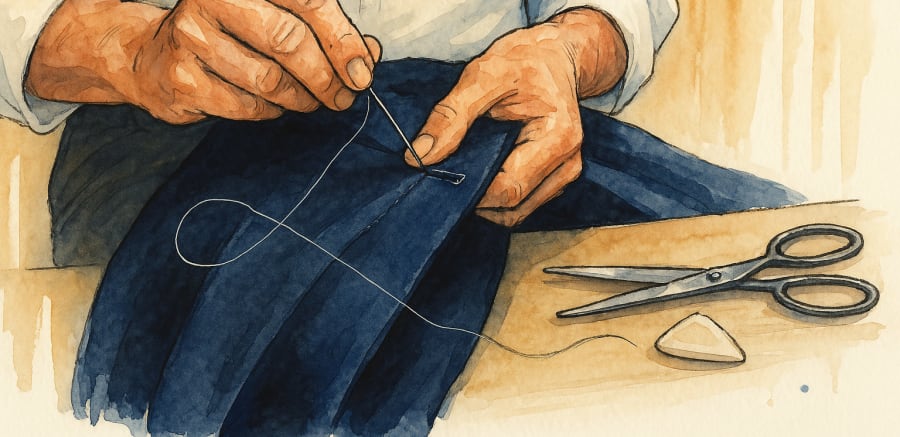
PROCESS: Horsehair/mohair canvas hand-stitched across the entire jacket. 'Floating canvas' technique: the canvas is attached by floating stitches allowing independent movement of the outer fabric and canvas. 20-30 hours of hand work. THE MAGIC OF FULL CANVAS: The suit 'lives' and moulds to your body over time. The canvas gradually softens according to your posture, creating a second skin. After 6 months of wear, the suit is UNIQUE to your body (impossible to lend - it is moulded to you). It improves with age.

The pinnacle. The suit becomes a living garment that evolves with you. A generational investment.

Technical Details of the Canvas

Expertise
Stacked horsehair canvas strips, ready to be built into a jacket

Canvas is not simply 'cloth'. It is a precise blend of horsehair, wool, and sometimes mohair, woven in a specific manner to achieve rigidity AND suppleness. A centuries-old technique, perfected over time.

  • Materials: Horsehair 30-40%, wool 50-60%, linen 10%
  • Origin: Italy (Piacenza, Como) and historically England
  • Weave: Twill allowing multi-directional flexibility
  • Attachment: Hand pad stitching every 1-2cm
  • Different zones: 3-4 canvas weights depending on jacket area
  • Total thickness: 0.8-1.2mm depending on area
  • Material longevity: Canvas lasts 30-50 years before degradation
  • Material cost: 30-50EUR/m2 (vs fused 2-5EUR/m2)
TRADITIONAL CANVAS COMPOSITION: 30-40% horsehair for resilient rigidity, 50-60% wool for softness and moulding capacity, 10% linen for strength. WEAVE: Twill allowing multi-directional flexibility. THICKNESSES: 3-4 different weights depending on the jacket zone (more rigid at the shoulders, more supple at the sides). ATTACHMENT: Hand pad stitching every 1-2cm, creating a 3D structure. This hand work is an art that only experienced tailors master.

The canvas is the invisible heart and soul of the suit. An investment in the unseen.

How to Identify a Suit's Construction

Practical Guide
How to Identify a Suit's Construction

Simple tests to identify a suit's construction, crucial when purchasing. Sales staff are not always forthcoming about the actual construction. Learn to verify for yourself.

  • Pinch-and-roll test: Pinch the lapel or chest. Gently roll the fabric between your fingers. Canvas = you feel 3 distinct layers (fabric-canvas-lining). Fused = a rigid, unified block sensation.
  • Suppleness test: Fold the lapel gently. Canvas = folds naturally, returns to shape. Fused = artificial resistance, returns to shape too quickly (spring effect).
  • Light test: Hold the jacket against a strong light. Canvas = you see the shadows of pad stitching (discreet grid pattern). Fused = uniformly opaque surface.
  • Lining test: Lift the interior lining. Canvas = you see the beige/grey horsehair canvas with visible stitching. Fused = you see white synthetic interlining bonded on.
  • Rebound test: Press firmly on the chest for 5 seconds. Release. Canvas = returns to shape slowly (10-15 sec). Fused = immediate rebound.
  • Ask directly: 'What is the construction? Full canvas, half canvas or fused?' If hesitation or vagueness = probably fused.
  • Price indicator: Under 500EUR = certainly fused. 500-1200EUR = probably half canvas. Over 1500EUR made-to-measure = should be full canvas (verify nonetheless).
These tests are reliable and can be performed discreetly in a shop or during a fitting. A combination of 2-3 tests is sufficient for certainty. Connoisseurs systematically use these methods before purchasing a suit over 800EUR.

These tests make you self-reliant. No longer trust blindly - verify the construction before paying.

Which Construction to Choose for Your Needs

Advice
Which Construction to Choose for Your Needs

The choice of construction depends on budget, intended use, and time horizon. Here are honest recommendations according to different profiles and needs.

  • FIRST made-to-measure suit: Half canvas (EUR 980-1,290). Discover made-to-measure without maximum investment. If satisfied, full canvas for the second suit.
  • DAILY office wear: Half canvas is optimal. 5-7 year durability, easy care. 2-3 half canvas suits are better than 1 full canvas for rotation.
  • SIGNATURE SUIT / WEDDING: Full canvas is essential. Worn on important occasions for 15-20 years. The investment is justified by longevity and quality.
  • TIGHT BUDGET under 1000EUR: Quality half canvas OR premium off-the-rack with alterations. Avoid low-end full canvas (poor canvas is worse than good fused).
  • FIRST tailoring experience: Half canvas. Test the relationship with the tailor before investing in full canvas. Change tailors if dissatisfied without financial regret.
  • COLLECTOR / CONNOISSEUR: Full canvas only. You know what you are purchasing and will appreciate the difference.
  • HOT CLIMATE wear: Half or full canvas (breathability). Never fused (does not breathe = discomfort in heat).
There is no absolutely wrong choice - only a choice mismatched to your needs. Be honest about actual use and available budget. A well-maintained half canvas suit is worth more than a neglected or over-budget full canvas.

The best construction is the one suited to YOUR actual needs, not an absolute rule.

Frequently asked questions

Before you begin.

It depends on your time horizon and usage. CALCULATION: Half canvas 1290EUR, lifespan 7 years regular wear = 184EUR/year. Full canvas 1790EUR, lifespan 15 years = 119EUR/year. Long term, full canvas is LESS EXPENSIVE per year. BUT requires a higher initial investment. IF you wear a suit 2+ times per week for 10+ years: full canvas is absolutely worthwhile. IF occasional wear (weddings, events): half canvas is more than sufficient. IF tight immediate budget: half canvas, upgrade to full canvas for the next suit. No wrong choice - only a choice suited or not to your situation.

Rarely, and only in their very high-end ranges (over 2500EUR). REALITY: Armani under 1500EUR = fused. Hugo Boss standard = fused. Even 'luxury' ranges at 1800-2500EUR are often half canvas at best. Full canvas is reserved for prestige collections (Purple Label, high-end Made to Measure). WHY: Industrial-scale production requires compromises. Full canvas is artisanal, slow, impossible to industrialise. CONSEQUENCE: A made-to-measure half canvas suit at 1290EUR from a tailor surpasses a 1800EUR branded fused suit. You pay for the logo and marketing, not the construction. Made-to-measure directs your money towards the product, not advertising.

From rules to practice · Paris 7th

The advisory appointment covers buttoning, colour pairings and the mistakes to avoid, with your adviser. No obligation.