
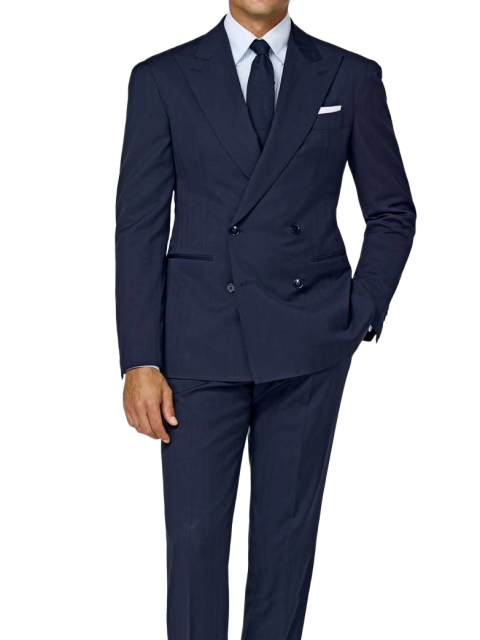


Style guide · Atelier Mesure, Paris 7th
Men's Suit Body Type Guide
Choosing the cut suited to your body type. The tailor's secrets to flattering every silhouette and correcting proportions.

Tailoring the Suit to Your Body Type
A made-to-measure suit does more than follow your measurements - it optically corrects your proportions to create a harmonious silhouette. Tailors classify men's body types into four main categories: H (rectangle), V (inverted triangle with broad shoulders), A (triangle with wider hips), and O (round). Each body type requires specific adjustments. Made-to-measure excels precisely in this morphological adaptation. Where off-the-rack imposes a standard cut, made-to-measure creates the illusion of ideal proportions. This guide explains how to optimise your suit according to your body type.
- Goal: create an inverted V silhouette (broad shoulders, defined waist, narrow hips)
- Made-to-measure allows invisible corrections that flatter naturally
- See our measurement guide for precise measurements
V Body Type (Inverted Triangle - Broad Shoulders)
Athletic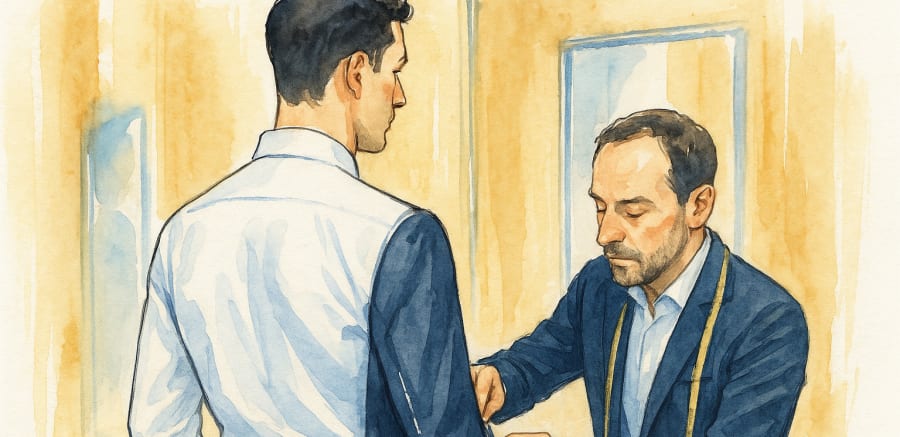
- CHARACTERISTICS
- Broad shoulders, developed torso, narrow waist and hips. Natural athletic V-shaped silhouette. Often the result of sport (swimming, weight training).
- ADVANTAGES
- Ideal masculine body type. Close to the desired inverted V. Suits flatter naturally.
- CHALLENGES
- Risk of appearing too heavy in the upper body. Trousers may look narrow in proportion.
- CUT SOLUTIONS
- *Jacket*: Natural shoulders without excessive padding (avoid accentuating width). Standard notch lapel (not wide peak lapels that visually broaden). Defined waist suppression to refine the silhouette. Standard or slightly longer length to balance. *Trousers*: Straight or slightly tapered cut (avoid slim which accentuates disproportion). Trousers with mid-rise to elongate the legs. Pleats for volume and elegance.
- FABRICS
- Avoid horizontal stripes across the shoulders. Favour plain or micro-patterns. Vertical herringbone works well.
- RECOMMENDED STYLE
- Two-piece suit is sufficient. Three-piece risks making the torso appear heavier. Classic business suit.
- CELEBRITIES
- Daniel Craig, Chris Hemsworth, Dwayne Johnson.
H Body Type (Rectangle)
Lean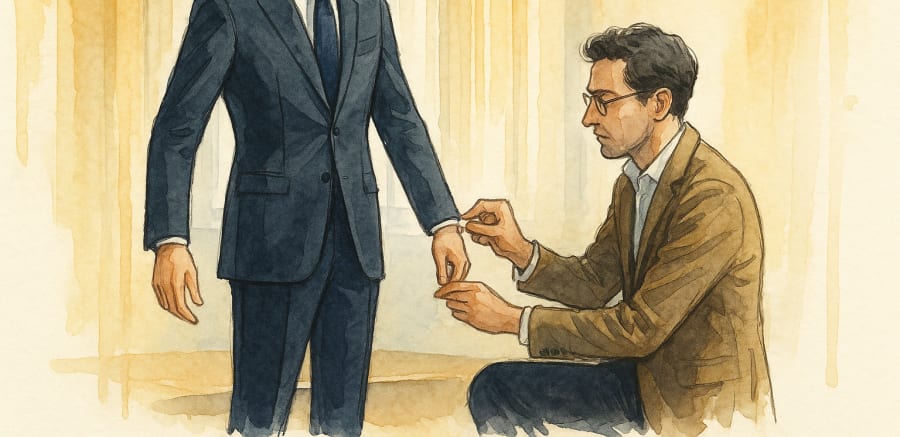
- CHARACTERISTICS
- Shoulders, waist and hips vertically aligned. Straight silhouette without marked curves. Lean, often slender build. Waist naturally undefined.
- ADVANTAGES
- Elegant, slender silhouette. Wears structured garments well. Easy to find sizes (balanced proportions).
- CHALLENGES
- Lack of waist definition means the silhouette can appear bland. Risk of looking too thin if very slim. No natural relief.
- CUT SOLUTIONS
- *Jacket*: DEFINED waist suppression is essential to create a waist artificially. Slightly structured shoulders to broaden the upper body (create the V). Buttons positioned to create a focal point at the waist. Jacket close to the body but not slim (avoid accentuating thinness). *Trousers*: Classic straight cut. Pleats to add volume and structure. Avoid overly fitted trousers that accentuate the straight line.
- THREE-PIECE IS ESSENTIAL
- The waistcoat is your greatest ally. It artificially creates a defined waist and adds structure to the torso. The three-piece suit transforms the H body type.
- FABRICS
- Avoid vertical stripes that accentuate length. Favour textures (flannel, tweed) that add volume. Prince of Wales checks work well (add visual width).
- ACCESSORIES
- Visible belt (not braces which accentuate the vertical line). Pocket square to add volume at the chest.
- CELEBRITIES
- Ryan Gosling, Benedict Cumberbatch, Eddie Redmayne.
O Body Type (Round)
Full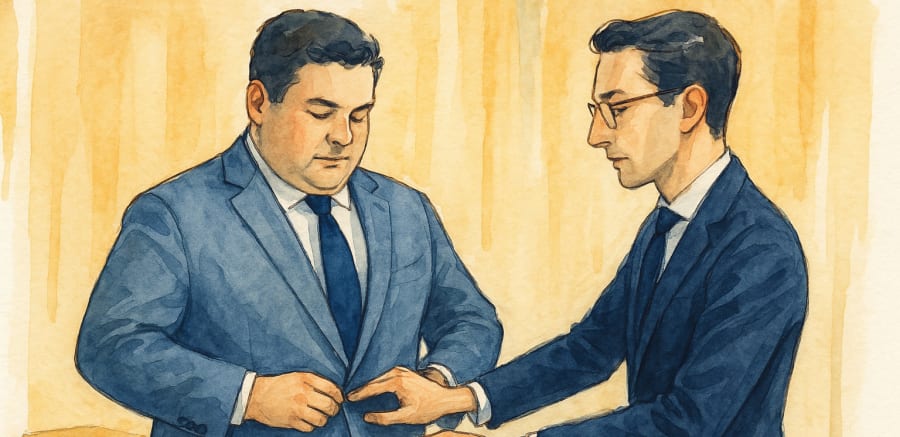
- CHARACTERISTICS
- Prominent midsection, rounded shoulders and hips. Volume concentrated at the centre of the body (abdomen). Waist undefined. Common body type for men over 40.
- ADVANTAGES
- Natural presence; an imposing build can be very flattering when well dressed.
- CHALLENGES
- Risk of appearing untidy if the suit fits poorly. Jacket buttons pull if too tight. Tendency towards overly loose garments to hide volume (counterproductive).
- CUT SOLUTIONS
- *Jacket*: Jacket CLOSE to the body but not tight. A loose jacket makes you look larger. Slightly longer length to cover the seat and create a vertical line. Standard notch lapel (avoid wide lapels). Single-button fastening recommended (avoid double-breasted which broadens). Natural shoulders without padding. *Trousers*: BRACES ARE ESSENTIAL. A belt compresses the abdomen uncomfortably and creates a visible bulge. Braces hold trousers at the natural waist without compression. High-waisted trousers (at navel level) worn with braces elongate the legs. Classic straight cut (never slim). Pleats for ease around the abdomen.
- NEVER THREE-PIECE
- A waistcoat accentuates the midsection and adds bulk. Always two-piece.
- FABRICS
- Dark plain fabrics (navy, charcoal grey) have a slimming effect. Avoid light, shiny fabrics with large patterns. Matte flannel works well. Avoid horizontal stripes. Discreet vertical stripes elongate.
- STYLE
- Classic business suit well fitted. Avoid double-breasted suit which broadens.
- CELEBRITIES
- James Corden, John Goodman, Brendan Gleeson (well dressed).
A Body Type (Triangle - Wider Hips)
Rare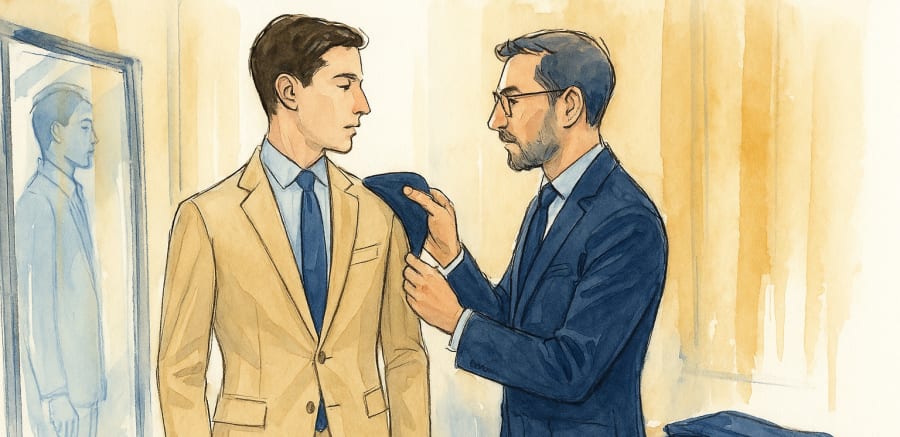
- CHARACTERISTICS
- Narrow shoulders, wider hips and thighs. Pear-shaped or triangular silhouette. A rare body type in men but it does exist. Waist often defined.
- CHALLENGES
- Visual imbalance between upper and lower body. Shoulders appear narrow. Hips and thighs draw the eye. Difficulty finding off-the-rack suits (jacket and trousers require different sizes).
- CUT SOLUTIONS
- *Jacket*: STRUCTURED shoulders with padding to artificially broaden the upper body. Wide peak lapels to accentuate shoulder width. Chest pockets and pocket square to add upper body volume. Jacket with waist suppression to define the waist. Standard length (not too long). Jacket colour may be lighter than trousers (draws the eye upward). *Trousers*: Generous straight cut (avoid too fitted on the thighs). Dark colour to minimise lower body volume. No trouser turn-ups (they shorten the legs). Perfect length (touches the shoe without excessive break).
- THREE-PIECE IS IDEAL
- Waistcoat adds structure and volume to the upper body. Rebalances proportions.
- FABRICS
- Jacket: tweed, flannel, textures that add volume. Patterns on the upper body (checks at the chest). Trousers: dark plain without patterns.
- DOUBLE-BREASTED IS AN OPTION
- Double-breasted suit broadens the chest, ideal for rebalancing.
- ACCESSORIES
- Pocket square is essential (draws the eye upward). Avoid a conspicuous belt (draws the eye to the hips).
- CELEBRITIES
- A rare body type among celebrities - most compensate with sport.
Corrections by Height & Build
Proportions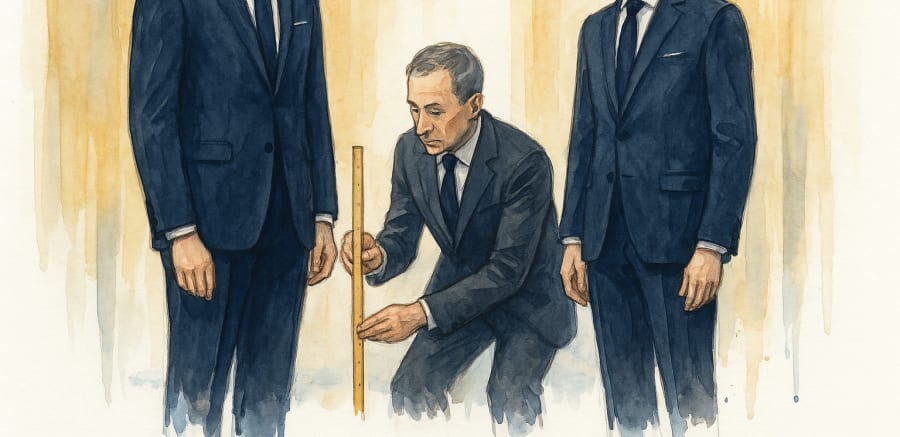
- TALL MEN (>1m85)
- *Challenge*: Appearing too elongated; sleeves and trousers too short off-the-rack. *Solutions*: Slightly longer jacket (covers the seat without exaggeration). Wide lapels proportionate to height. Trousers with pleats for volume. Three-piece adds structure without elongating. Avoid fine vertical stripes (accentuate height). Favour discreet horizontal patterns, checks. Tie width 9-10cm (proportionate).
- AVERAGE BUILD (1m70-1m85, normal weight)
- *Advantage*: Standard proportions, maximum style flexibility. *Advice*: Experiment with cuts and styles. Two or three-piece according to preference. All suit styles are accessible. Focus on perfect fit rather than optical corrections.
Universal Advice for All Body Types
Essentials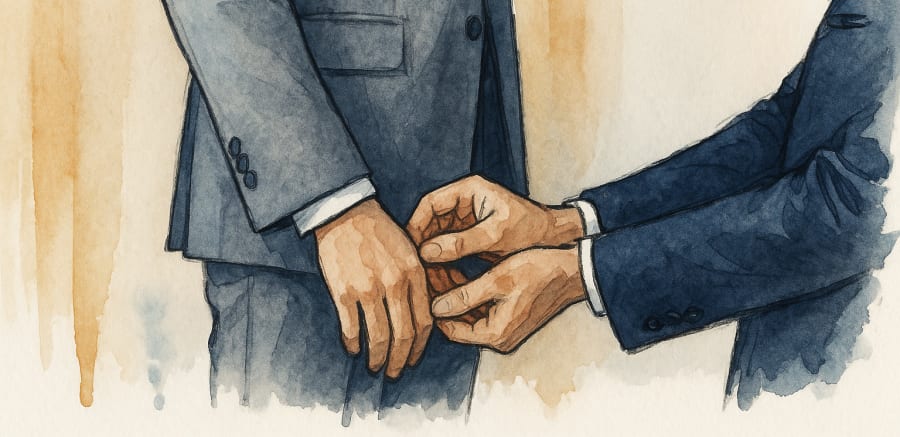
- JACKET LENGTH
- The bottom of the jacket should cover the seat. Test: arms by your sides, curled fingers touch the bottom of the jacket. Too long = shortens the silhouette. Too short = inelegant.
- SLEEVE LENGTH
- Jacket sleeve ends at the wrist bone. 1-1.5cm of shirt shows below the jacket sleeve. Never invisible shirt (sleeve too long) nor too much shirt (sleeve too short - 2cm maximum).
- SHOULDERS
- The shoulder seam falls EXACTLY at the edge of the natural shoulder. Neither before (jacket too small, pulls) nor after (jacket too large, droops).
- TROUSER LENGTH
- Trousers touch the shoe with a slight break (1-2cm of fabric folding onto the shoe). No break = too short. Multiple breaks = too long, untidy.
- JACKET WAIST
- The jacket should follow the natural line of the torso with defined waist suppression. Test: buttoned, slide your hand flat under the jacket at the chest. It should pass through snugly without pulling.
- BUTTONS
- The last jacket button is ALWAYS left undone. Two-button jacket: fasten the top. Three-button jacket: fasten one or two from the middle.
- MADE-TO-MEASURE IS ESSENTIAL
- These adjustments are impossible with off-the-rack. Made-to-measure creates a suit fitted to YOUR specific body type. An investment that transforms your silhouette.
Common Fit Errors to Avoid
Pitfalls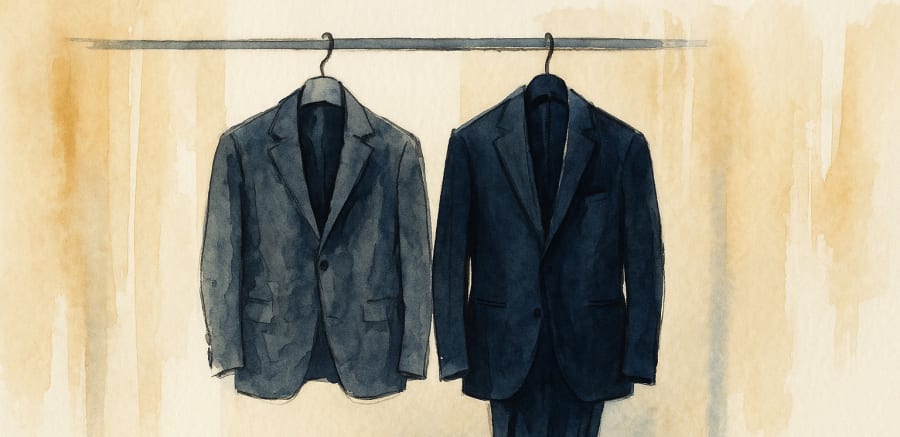
Even with a made-to-measure suit, certain fit errors recur frequently and betray a careless fit or choices poorly suited to the body type. Identifying them allows correction at the fitting stage.
- DROOPING SHOULDERS
- The shoulder seam extends beyond the natural shoulder, creating a sagging effect. Common when choosing a size too large for comfort.
- JACKET TOO SHORT
- The bottom of the jacket does not cover the seat, visually shortening the torso. A common error among tall men wearing off-the-rack.
- X-SHAPED BACK
- X-shaped creases across the back indicate a jacket too tight at the shoulder blades. The fabric pulls between the shoulders and waist.
- TROUSERS THAT GAP
- An overly low rise creates a billowing effect between the legs. This gives an untidy appearance even with a fine fabric.
- COLLAR LIFTING AWAY
- The back of the jacket collar lifts away from the shirt collar, a sign of a posture issue left uncorrected. The tailor must adapt the cut to your actual posture, not an idealised one.
Fitting Checklist: Verifying the Fit
Practical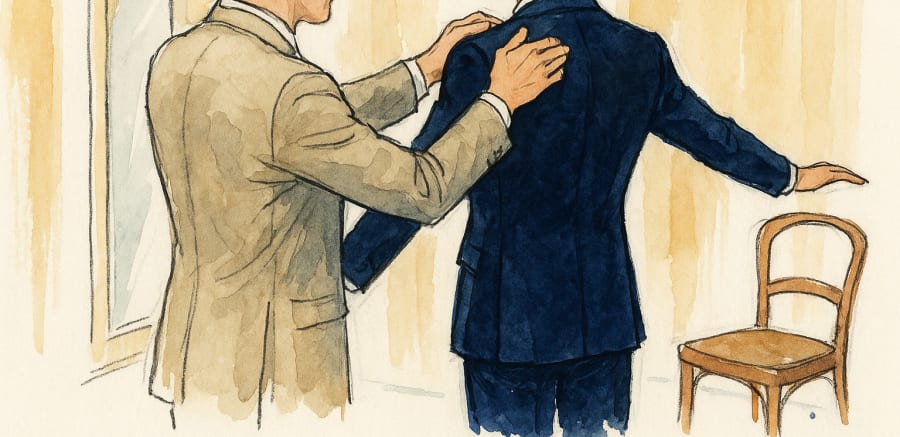
During a made-to-measure suit fitting, this systematic checklist ensures an impeccable fit. Proceed point by point, standing then seated, to leave nothing to chance.
- SHOULDERS
- The seam falls exactly at the edge of the shoulder bone. Raise your arms: no discomfort or excessive tension.
- COLLAR
- The jacket collar sits perfectly against the shirt collar along its entire length, with no gap or bunching. Turn your head left and right to verify.
- CHEST
- Jacket buttoned, slide your hand flat under the lapel. It passes through snugly without the fabric pulling. If the buttons pull or form an X, the jacket is too tight.
- SLEEVES
- 1 to 1.5cm of shirt visible below the jacket sleeve. Both arms should show the same cuff length.
- JACKET LENGTH
- Curled fingers touch the bottom of the jacket, arms by your sides. The jacket fully covers the seat.
- TROUSERS
- A slight break on the shoe. No excessive creasing at the knees. Seated, the trousers should not ride above the sock.
- SEATED TEST
- Sit down, cross your legs. No excessive tension; the fabric follows natural movement.
Key takeaways
Golden Rules: Body Type & Suit
- Universal goal: create an inverted V silhouette (broad shoulders, defined waist, narrow hips)
- H body type: three-piece is essential to create waist definition. Defined waist suppression is key
- O body type: braces are essential, no waistcoat, dark plain fabrics
- A body type: structured shoulders, three-piece or double-breasted, dark trousers
- Made-to-measure is essential: these corrections are impossible with off-the-rack, even with alterations
Frequently asked questions
Before you begin.
From rules to practice · Paris 7th
Further reading
