


Craft10 April 20263 min read
Canvassing: what you cannot see, and what it decides.
Between the cloth and the lining of a jacket, a canvas decides its shape, how it ages and how it follows the chest. Three constructions, three different garments.
By Gilles Masson, Atelier Mesure, Paris 7ᵉ

Open a jacket and slide a hand between the cloth and the lining, at chest height. What you feel, or fail to feel, is what separates a garment that will hold its shape for ten years from one that will lose it in two seasons. That invisible layer is the canvas.
Fused: glue instead of canvas
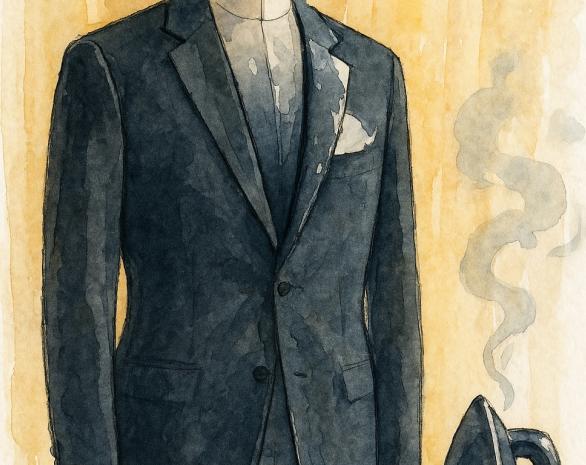
In a fused jacket, a synthetic interlining is bonded with heat to the back of the cloth. It is quick, it is consistent, and it gives a clean front from the very first day.
The fault shows later. The adhesive ages, especially after several cleanings: it lifts in patches and the front begins to bubble, those small irregular ripples across the lapel and chest. A jacket that bubbles cannot be saved. It is the most reliable way to date a construction.
Half-canvassed: canvas where it earns its place
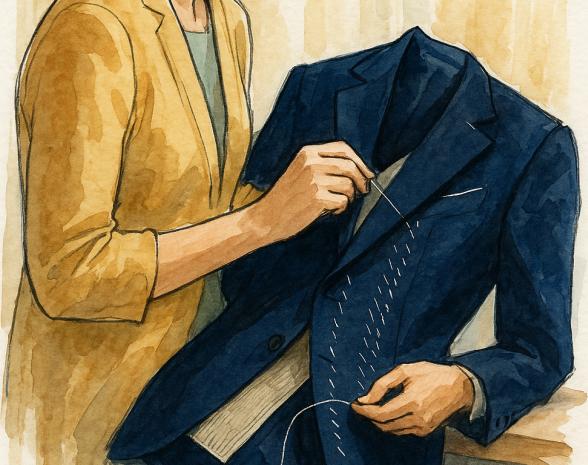
Half-canvassing lays a floating canvas across the upper front, chest and lapel, and leaves the lower part fused or free. The canvas is not glued: it is held by stitches, so it can move with the cloth.
This is the best balance of structure and softness for a garment worn every day. The lapel takes a natural roll instead of a pressed crease, and the chest hollows slightly to follow the torso. For most working suits, it is the right construction.
Fully canvassed: canvas to the hem
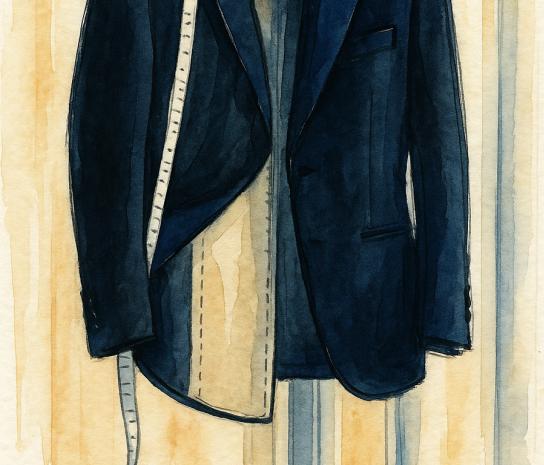
The canvas runs down to the hem. The garment takes longer to build, weighs a few dozen grams more, and behaves differently over time: it slowly deforms to the shape of the man wearing it, rather than resisting and then giving way.
This construction earns itself on pieces meant to last: ceremony suits, jackets in noble cloth, the dinner jacket. It asks for a cloth that deserves it, since building a full canvas onto a mediocre fabric is laying foundations for a shed. The full comparison of the three constructions is here: constructions and canvassing.
« Quality is what remains once the price has been forgotten. »
Key points
Recognising a construction in three gestures.
- Pinch the front between two fingers: two free layers mean a canvas
- Look at the lapel in profile: a soft roll, not a pressed crease
- Look for ripples on an older garment: that is the glue letting go
- Half-canvassing suits the great majority of working suits
- Full canvassing earns itself on pieces meant to last
- A full canvas on a mediocre cloth saves nothing
- Repeated dry cleaning accelerates the ageing of a fused front
Canvassing is the only part of a jacket you pay for without ever seeing it, and the first you regret ten years later. It is also why, with the same cloth, two jackets behave differently. See how a suit is made, stage by stage.
