


Style icons24 July 20263 min read
Alain Delon's wardrobe: French style in the sixties.
Pale suits, open collars, lean silhouettes: a Mediterranean elegance that owes as much to the cut as to the way it is worn. What is still useful today.
By Gilles Masson, Atelier Mesure, Paris 7ᵉ
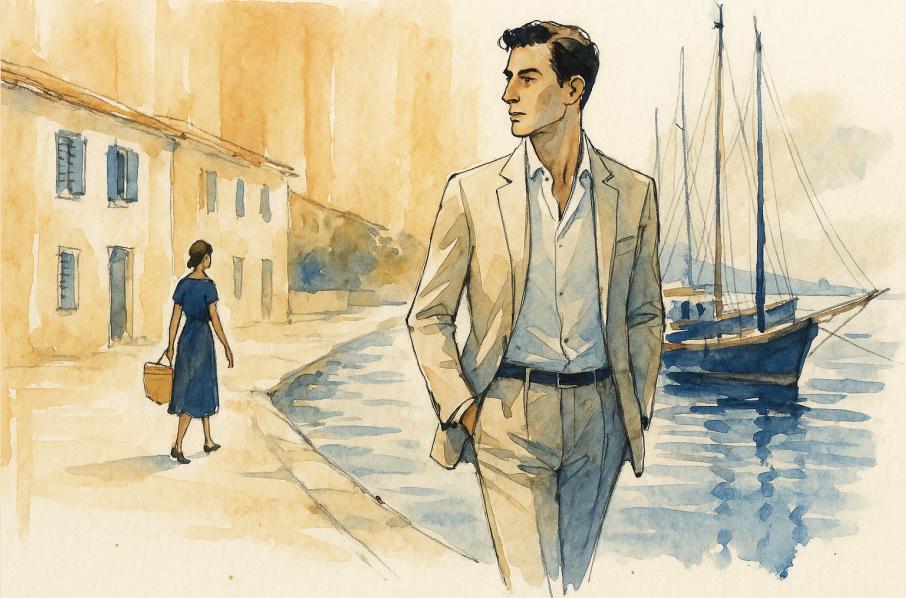
There is a French way of being elegant that never chased English perfection or Italian softness. Alain Delon's wardrobe in the nineteen sixties is its clearest expression: simple garments worn without ceremony, a lean silhouette and an offhandedness that does not exclude rigour.
Three lessons in cut
Pale suits
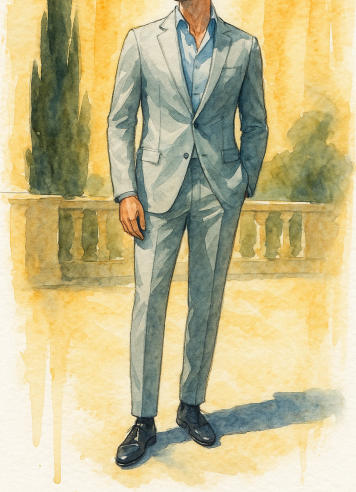
Beige, pearl grey, sky blue: pale suits hold a place the French wardrobe has rarely given them back since. They work because they are worn outdoors, in full daylight, in southern light. That is the first lesson, and it is technical: a pale shade demands a truer cut, forgives no excess room and shows every fold. A badly cut pale suit looks wide; well cut, it lengthens.
The narrow shoulder and high waist
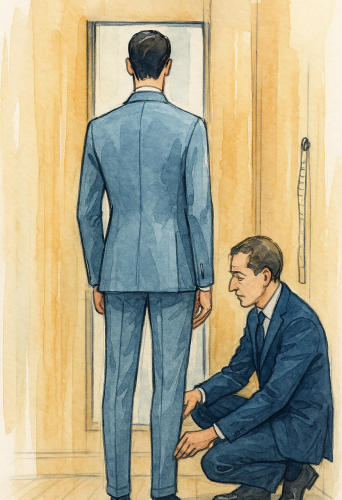
The sixties silhouette rests on two things: a narrow, lightly padded shoulder that stops exactly at the joint, and a trouser worn high, at the true waist rather than on the hips. That combination lengthens the leg and shortens the torso, precisely the opposite of what a low trouser produces. A made-to-measure trouser is the only way to set that height precisely.
The open but structured collar
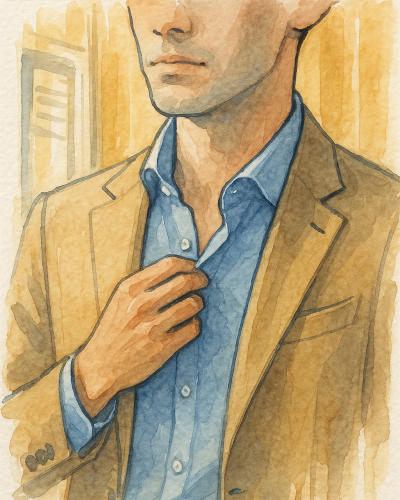
Delon often wears the shirt open, without a tie, under a suit jacket. That is unremarkable now; it was not then, and the success rested on one detail: the collar is structured, never soft. A collar that collapses onto the lapel reads as undone; a lightly structured one stays open while holding its line. That is the difference between ease and neglect, and it is settled when the shirt is designed, not when you get dressed.
Seven markers
Key points
The French wardrobe, seven markers.
A pale suit demands a truer cut than a dark one
The shoulder stops at the joint, without marked padding
The trouser sits at the true waist, not on the hips
A high waist lengthens the leg and balances the silhouette
An open collar only works if it is structured
Offhandedness is prepared: it is never improvised
Few pieces, very well cut, worn often
What remains useful
There is nothing unreachable about this wardrobe: two suits, a few shirts, simple shoes. Its difficulty lies elsewhere, in the accuracy of the cut, which is precisely what made-to-measure knows how to give. See our pages on the made-to-measure suit and the made-to-measure shirt.
