


Style12 June 20263 min read
Wearing a suit at thirty degrees: what really changes.
Heat is not beaten with a finer cloth but with a differently built garment. Lining, weave, cut: what genuinely affects comfort.
By Gilles Masson, Atelier Mesure, Paris 7ᵉ
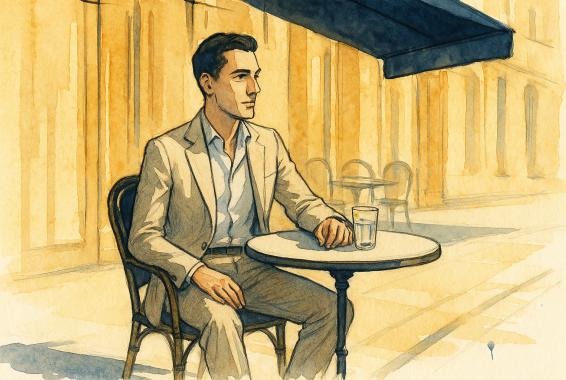
Every summer brings the same received idea: to feel cooler, take a finer cloth. It is the least effective answer, and sometimes the worst. What makes the difference in real heat is not the thickness of the cloth but the way air moves through the garment.
Weave matters more than weight
A warm cloth is not a heavy cloth, it is a closed one. A fine wool with a very tight weave traps air against the skin; a thicker woollen with an open weave, a fresco for instance, lets air through and dries quickly.
The test is one gesture: hold the cloth up to the light. If you can see a grain, small regular gaps, it breathes. If it is opaque and smooth as a sheet of paper, it will be warm whatever its weight. That is the criterion to ask for when you choose the cloth.

The lining, the real lever
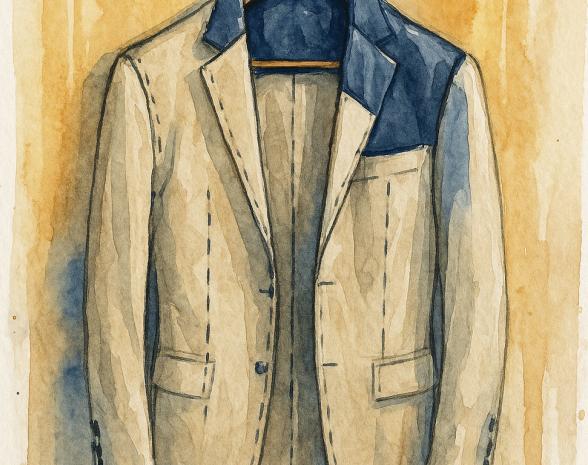
A fully lined jacket puts two layers across the whole torso. Removing the lining from the back, keeping only the shoulder facings and the sleeves, changes the sensation more than two hundred grams off the cloth.
This is called a half lining, or an unstructured jacket when you go further and lighten the construction as well. The garment loses a little structure and gains a great deal of breathability. It is a decision to take at the first appointment, not an option to add afterwards.
Colour and cut, at the margin
A pale shade reflects light and wears better in full sun, that is true, but the effect is marginal next to the lining. Its real advantage is that it shows perspiration less than a navy or a charcoal.
The cut works the same way: a little extra room under the arms and across the back lets air move, without the garment looking loose. Two centimetres well placed beat a whole size. Summer suits are designed on these three settings together.

« Fashion fades, only style remains the same. »
Key points
Seven settings for summer.
- Look at the weave before the weight
- An open fresco breathes better than a fine, closed wool
- Ask for a half lining: it is the most effective lever
- Consider an unstructured build for the hottest days
- Prefer mid or pale shades, which show marks less
- Add a little room under the arms rather than a whole size
- Choose a shirt in an open-weave cotton, not a tight poplin
A good summer suit is not noticed for being light; it is noticed because the man wearing it is still comfortable at four in the afternoon. All of it is decided at the first appointment, at the same time as the cloth.
